Transparency portal

...

Clinical research at the Leukemia Institute

Clinical research at the Leukemia Institute

Your doctor has detected abnormalities in your blood test results corresponding to an excessive number of white blood cells (hyperleukocytosis) and/or a decrease in certain blood cells (neutrophils, hemoglobin levels reflecting red blood cells, or platelets).

These abnormalities prompted your consultation or hospitalization because they raised suspicion of a blood disorder (hematological disease).

After initial investigations, your doctor diagnosed you with leukemia, and you agreed to participate in the Leukemia Institute’s prospective registry to better understand the origin of these hematological diseases and monitor their progression during the various treatments that may be offered.

The Leukemia Institute in figures

1st

leukemia treatment center in France

10

clinical services

16

research teams

4

medical biology laboratories

Clinical services

Department of Adult Hematology, Olivier Hermine

Necker Hospital

149 rue de Sèvres 75015 Paris

Department of senior hematology, Lionel Adès

Saint-Louis Hospital

1 avenue Claude Vellefaux 75010 Paris

Outpatient Hemato-oncogenetics Unit, Marie Sébert

Saint-Louis Hospital

1 avenue Claude Vellefaux 75010 Paris

Adolescent and Young Adult Unit, Nicolas Boissel

Saint-Louis Hospital

1 avenue Claude Vellefaux 75010 Paris

Department of clinical hematology and cell therapy, Thorsten Braun

Avicenne Université Sorbonne Paris Nord Hospital

125 Route de Stalingrad 93000 Bobigny

Department of Pharmacology and Clinical Investigations, Vincent Lévy

Saint-Louis Hospital

1 avenue Claude Vellefaux 75010 Paris

Hematology Transplant Unit , Régis Peffault de Latour

Saint-Louis Hospital

1 avenue Claude Vellefaux, 75010 Paris

Department of adult hematology, Emmanuel Raffoux

Saint-Louis Hospital

1 avenue Claude Vellefaux 75010 Paris

Department of clinical haematology, Olivier Hermine

Cochin–Port Royal Hospital

27 rue du Faubourg Saint Jacques – 75014 Paris

Department of Paediatric Hematology and Immunology, Jean-Hugues Dalle

Robert-Debré Hospital

48 boulevard Sérurier 75019 Paris

DREAM study

As part of the standard care for your disease or as part of a protocol, your doctor has offered you a treatment based on azacitidine, combined with either venetoclax or ivosidenib depending on the characteristics of your disease, with the aim of achieving remission. The clinical efficacy of these treatments has been established. They are internationally recognized standard treatments for your disease. However, it has been established that even when the first course of treatment is maximally effective, some residual leukemia cells remain, requiring further cycles of treatment after complete remission has been achieved.

The research proposed as part of the DREAM study aims to determine whether it is possible, based on laboratory analysis of blood or bone marrow samples, to predict the effectiveness of treatment, but also to improve biological knowledge about the minority of residual leukemia cells in order to identify ways to improve these treatments.

To do this, the DREAM study relies on new technologies available at the Leukemia Institute, which enable leukemia cells to be cultured in vitro to determine their response to treatment, or to study how diseased cells react to treatment using a blood or bone marrow sample (a technology known as “single-cell sequencing”).

To answer the question posed in the research, this bicentric study with minimal risks and constraints planned to include 120 people newly admitted to the St Louis Hospital and Avicenne Hospital for AML.

Before starting the first course of treatment, then during the administration period of this first course (4 to 10 days), and finally when evaluating the response to the first and sixth cycles (generally between 21 and 56 days after the start of the cycle), your doctor will prescribe various biological tests (cellular, molecular, protein, and microbiological) of your blood and bone marrow at regular intervals in order to better characterize the disease, monitor its progression during treatment, and monitor the effects of the disease and its treatment on your health.

In the proposed research, we will conduct biological studies on additional blood or bone marrow samples at certain key moments during treatment:

  • just before treatment begins
  • in the first few hours after administration
  • on the 2nd and 7th days of the cycle
  • then when evaluating the response to the first cycle and after six cycles)

This study aims to validate an in vitro drug response test as a “biomarker” of treatment response. It also aims to refine our understanding of the molecular consequences of these drugs’ action on leukemia cells, and in particular to determine the heterogeneity of response from one cell to another. It is therefore conducted purely for research purposes and will not result in any changes to the treatments your doctor will administer to you. The results of these biological studies will be obtained after your medical treatment has been completed and will have no impact on it.

These additional tests may require up to 6 additional blood tubes (30 mL) to be drawn, most often during a blood draw already scheduled for your monitoring. It is possible that adherence to the study blood draw schedule may result in an additional blood draw. Similarly, an additional 2 mL of bone marrow will be collected during a bone marrow puncture performed at the start of treatment, during the first cycle, and then during the reassessment at the end of the first cycle. While it is standard practice to perform a bone marrow puncture after the first cycle of treatment, an additional intermediate puncture will be performed around the 7th day of treatment as part of this study. This will be crucial in enabling the research physicians to understand the mechanism of action of the treatments, with a view to ultimately improving their efficacy.
Finally, if you give your specific consent, your doctor will perform a biopsy under local anesthesia instead of a simple bone marrow aspiration before starting treatment. This procedure, which is part of the routine tests for certain blood and bone marrow diseases, is generally performed if the aspiration fails.

With your specific consent, this examination will be performed immediately, and if necessary during the reassessment. In addition to the diagnostic information usually obtained with a fine needle aspiration, it will provide information on their spatial organization that only a needle biopsy can provide. New technologies (spatial transcriptomics) will enable medical researchers to better understand how diseased cells are distributed in the bone marrow and with which normal cells in the body (immune system cells, support cells known as “stromal” cells) they interact. This will ultimately lead to the development of new treatment options.

The estimated duration of the study is 38 months, and your participation will be 56 days. After signing your consent form, the study will proceed as follows:

  • As soon as the initial assessment of the disease has been completed, the following will be performed:
    – A 2 mL bone marrow sample will be taken during the initial myelogram assessment of the disease.
    – Optionally, if you have specifically consented to it, this myelogram (puncture-aspiration) will be replaced by a puncture-biopsy (“bone marrow biopsy”) under local anesthesia.
    – A 30 mL blood sample will be taken before any anti-leukemia treatment, preferably on the same day as the initial myelogram.
  • A new 30 mL blood sample will then be taken
    – On the evening of Day 1 of the first cycle, between 6 and 12 hours after the first dose of venetoclax (or ivosidenib) was administered (“lysis assessment”),
    – On Day 2 of the first cycle, before the second dose of venetoclax (or ivosidenib)
    – On the day of remission assessment (between Day 21 and Day 56 after the start of the first cycle).
  • A new 2 mL bone marrow sample will then be taken
    – Around the 7th day of the cycle (between the 4th and 10th day)
    – During the evaluation myelogram of the first and 6th cycles (between the 21st and 56th day after the start of the cycle).
    – Optionally, if you have specifically consented to it, this myelogram (aspiration) will be replaced by a biopsy (“bone marrow biopsy”) under local anesthesia.

By participating in this research, you will contribute to a better understanding of how leukemia treatments work.

As part of this academic research, no financial compensation is provided in return for your participation.

The limitations of this study are related to the need to take samples at a fixed time or on a fixed day, and to make it mandatory to perform an intermediate reassessment myelogram. These limitations are minimal because blood samples can usually be taken during the blood tests required for the routine management of your disease, without the need for additional venipuncture, and because the addition of an intermediate evaluation myelogram has no impact on medical management. Blood and bone marrow samples may cause a temporary discomfort at the time of the puncture, as well as a bruise at the puncture site.

If you agree to participate, you must comply with the following points:

  • Attend appointments. If you are unable to attend, please contact your doctor as soon as possible.
  • Follow your doctor’s recommendations regarding your participation in the study.
  • Inform the research doctor of any treatment you are receiving and any events that occur during the study (hospitalization, pregnancy, blood tests performed in the last month).
  • Be affiliated with a social security system or be a beneficiary of such a system.

After being collected, blood and bone marrow samples will be separated into plasma, cells, and tissue sections (for biopsies). Some of these samples will be cryopreserved at the INSERM U944 unit at Saint-Louis Hospital (Institut de Recherche Saint-Louis) for future use. This biological collection will be reported to the Ministry of Research and the Regional Health Agency (Article L. 1243-3 of the Public Health Code). Another part will be used directly for molecular and/or cellular analyses (RNA and/or DNA sequencing on single cells, flow cytometry, plasma protein assays). Most of these analyses will be conducted at the Hôpital Saint-Louis (Institut de Recherche Saint-Louis).

However, it is possible that certain specific analyses of biological samples or their derivatives (RNA, DNA, proteins, cells, etc.) may be conducted by external academic partners in France, Europe, or elsewhere in the world, or may be outsourced to biotechnology companies in France, Europe, or elsewhere in the world. Where applicable, such shipments will be subject to obtaining an export authorization for biological samples derived from human beings issued by the Ministry of Research, in accordance with Articles R.1235-7 et seq. of the Public Health Code.

At the end of the study, unused samples will be stored for future research on the pathology studied. The biological collection obtained as part of this study will be unique due to the availability of samples obtained during treatment, and not just at diagnosis.

The stored samples and anonymized data will be accessible to THEMA investigators. Access (transfer or assignment) by academic research partners may be requested on the basis of annual calls for projects at the end of this research, and scientific projects must be approved by the DREAM study Steering Committee.

Biological samples will be labeled “THEMA – DREAM biobank” and stored for a maximum period of 25 years (20 years after the end of this research) in the INSERM U944 unit of the Saint-Louis Research Institute. Raw data from correlative biological analyses will be stored securely on the server in the MEARY building at the Saint-Louis Hospital. Secondary data (biomarkers) from this research will be compiled in the eTHEMA study’s clinical data collection and managed by the Clinical Research Unit at Saint-Louis Hospital. This data will be stored for 25 years after the start of the DREAM study.

The DREAM study involves analyzing the somatic genetic characteristics of leukemia cells, excluding any constitutional genetic characteristics, i.e., those that could potentially be passed on to offspring. If a biological analysis of these samples were to suggest the study of transmissible genetic characteristics, you would be asked to provide a new, specific consent form.

You may at any time ask the physician supervising you in the context of the research to destroy these biological samples or to object to any further use of them.

If you do not participate in this study, your treatment will remain unchanged, as will the monitoring of blood tests during treatment and the bone marrow assessment at the beginning and end of the first treatment cycle.

At the end of your participation in the DREAM study, your medical care will continue unchanged, as will your participation in the eTHEMA registry, unless you also decide to end your participation in this registry. Your doctor may decide at any time to end your participation and will explain the reasons for doing so.

As part of the research in which you are being asked to participate, your personal data will be processed by AP-HP, the research sponsor and data controller, in order to analyze the results.

This processing is necessary for the research to be carried out, which is in line with the public interest mission entrusted to AP-HP as a public university hospital.

To this end, your medical data will be sent to the Sponsor or to people or partners acting on its behalf, in France or abroad. This data will be identified by a registration number and labeled “THEMA – DREAM database.” This data may also be sent to French health authorities, under conditions that ensure its confidentiality.
In addition to the sponsor and the investigators at the THEMA center, the only recipients of your coded personal data will be the following two subcontractors:
• The provider of the data collection software, hosted in France (the latter may not distribute or analyze the data).
• The study’s data management and biostatistics department, which is part of the THEMA center.

Your medical data that may be used to document a file for the competent authorities may be transmitted to a manufacturer so that a greater number of patients can benefit from the results of the research. This transmission will be carried out under conditions that ensure confidentiality.

Your data may be used for further research or analyses complementary to this research in collaboration with private or public partners, in France or abroad, under conditions that ensure their confidentiality and the same level of protection as European legislation.

You may object at any time to the further use of your data by the physician who is treating you as part of this research.

Your data will only be stored for as long as is strictly necessary and proportionate to the purpose of the research. It will be stored in the data controller’s information systems for up to ten years after the last publication of the research results.

Your data will then be archived in accordance with current regulations.
The computer file used for this research is implemented in accordance with French regulations (amended Data Protection Act) and European regulations (General Data Protection Regulation – GDPR). You have the right to access, rectify, restrict, and object to the processing of data covered by professional secrecy used in the context of this research. These rights can be exercised by contacting the physician in charge of the research, who is the only person who knows your identity (identified on the first page of this document).

If you decide to stop participating in the research, the data collected prior to this decision will be used in accordance with the regulations and exclusively for the purposes of this research. This is because deleting this data could compromise the validity of the research results. In this case, your data will not be used at any time in the future or for any other research.

If you encounter difficulties in exercising your rights, you can contact the AP-HP Data Protection Officer at the following address: protection.donnees.dsi@aphp.fr, who will be able to explain the remedies available to you through the CNIL. You may also exercise your right to lodge a complaint directly with the CNIL (for more information on this subject, please visit www.cnil.fr).

The AP-HP has taken all necessary measures to conduct this research in accordance with the provisions of the Public Health Code applicable to research involving human subjects.
The AP-HP has taken out insurance (0100518814033 230094) covering its civil liability and that of all parties involved with the company HDI–GERLING through BIOMEDICINSURE, whose address is Parc d’Innovation Bretagne Sud C.P.142 56038 Vannes Cedex.

The AP-HP obtained a favorable opinion from the Committee for the Protection of Persons for this research (Comité de protection des personnes Ile de France III) on September 12, 2023.

Your participation in this research is entirely voluntary. Your decision will not affect the quality of care and treatment you are entitled to expect.

Throughout the research, you may ask your doctor for information about your health and explanations about how the research is being conducted.
You may withdraw from the study at any time without justification, without any impact on the continuation of your treatment or the quality of care you receive, and without any impact on your relationship with your doctor. After withdrawing, you may continue to be treated by the same medical team. In this case, the data collected up to the time of withdrawal will be used for the analysis of the study results.

You may at any time ask the doctor supervising your research to destroy these biological samples or object to their further use.

Your medical file will remain confidential and may only be consulted under the responsibility of the doctor treating you, as well as by the health authorities and persons duly authorized by the AP-HP for research purposes and subject to professional secrecy.

At the end of the study and after analysis of the data relating to this study, you may be informed of the overall results by asking the doctor who is treating you as part of this study.

You may also access all of your medical data directly or through a doctor of your choice in accordance with the provisions of Article L 1111-7 of the Public Health Code.

After reading all this information, discussing all aspects with your doctor, and taking time to reflect, if you agree to participate in the research, you will be required to sign and date the informed consent form at the end of this document.

DYNHAEMICS study

Your doctor has detected abnormalities in your blood test results corresponding to an excessive number of white blood cells (hyperleukocytosis) and/or a decrease in certain blood cells (neutrophils, hemoglobin levels reflecting red blood cells, or platelets). These abnormalities prompted your consultation or hospitalization because they raised suspicion of a blood disorder (hematopathy) . After initial investigations, your doctor diagnosed you with acute myeloid leukemia (AML) and you agreed to participate in the prospective registry of the National Center for Precision Medicine (THEMA Program) set up by Saint-Louis Hospital to better understand the origin of these blood disorders and monitor their progression during the various treatments that may be offered.

As part of the standard treatment for your disease or as part of a protocol, your doctor has offered you a treatment combining two chemotherapy drugs (a drug from the anthracycline family: daunorubicin or idarubicin, combined with aracytine) with the aim of achieving remission of the disease. Depending on the characteristics of your disease or your participation in a protocol, these chemotherapy drugs may be administered to you as separate intravenous injections or in a combined form known as “liposomal” (CPX-351, Vyxeos®). The clinical efficacy of these treatments is well established and constitutes an internationally recognized standard treatment for your disease. However, it is known that even when this initial course of chemotherapy is maximally effective (achieving complete remission), some residual leukemia cells remain, requiring continued treatment after complete remission is achieved.


The research proposed as part of the DYNHAEMICS study aims solely to improve biological knowledge about this minority population of residual leukemic cells, in order to identify potential “Achilles’ heels” that could be targeted by new drugs in the future.

To achieve this goal, the DYNHAEMICS study relies on new technologies available at the Saint-Louis Research Institute, which make it possible to study, cell by cell, the molecular consequences of chemotherapy (using so-called “single-cell sequencing” technology).

To address the research question, this bicentric study, classified as involving minimal risk and constraint, plans to include 200 newly diagnosed patients with AML who are being treated at Saint-Louis Hospital and Avicenne Hospital.

Before starting the first course of chemotherapy, then during the period of chemotherapy administration (5 to 7 days), and finally when assessing complete remission (usually between 28 and 56 days after starting treatment), your doctor will prescribe various biological tests (cellular, molecular, protein, and microbiological) of your blood and bone marrow at regular intervals in order to better characterize the disease, monitor its progression during treatment, and monitor the effects of the disease and its treatment on your health.

In the proposed research, we will conduct biological studies on additional blood or bone marrow samples taken at key moments during chemotherapy treatment (just before its initiation, in the first few hours following its administration, on the 2nd, 3rd, and 8th days of the protocol, then at the end of aplasia and during the evaluation of the response to this first course of chemotherapy).
This study aims to refine, at the molecular level, our understanding of the molecular consequences of the action of chemotherapy drugs on leukemia cells and, in particular, to determine their heterogeneity from one cell to another. It is therefore conducted purely for research purposes and will not result in any changes to the treatments your doctor will administer to you. The results of these biological studies will be obtained after your medical treatment has been completed and will have no impact on it.
These additional tests may require a maximum of 4 additional blood tubes (20 ml) to be taken, most often during a blood test already scheduled for your monitoring. It is possible that compliance with the study’s sampling schedule may lead to an additional blood sample being taken. Except in exceptional cases, this can be done via a central venous line (catheter), without the need for an additional venipuncture. Similarly, an additional 2 mL of bone marrow will be collected during a bone marrow puncture performed at the start of treatment, during chemotherapy, and then at the time of re-evaluation. While it is customary to perform an intermediate bone marrow puncture on the 15th day after the start of treatment, this intermediate puncture will be performed on the 8th day of treatment as part of this study, instead of the analysis on the 15th day. Your participation in this study will therefore not result in a greater number of bone marrow punctures than for patients treated outside of this study.

The anticipated duration of the research study is 4 years and 90 days, and your personal participation will last 90 days.

After you have signed the consent form, the study procedures will proceed as follows:

At the time of the initial disease assessment, the following samples will be collected:

  • A 2 mL bone marrow sample, taken during the diagnostic bone marrow aspiration (myelogram) performed for initial disease evaluation.

  • Your treating physician may also propose, at the same time and under local anesthesia, to perform a bone marrow (osteomedullary) biopsy.

  • A 20 mL blood sample will be collected before any pre-treatment with hydroxyurea, ideally on the same day as the initial bone marrow aspiration.

Subsequent 20 mL blood samples will be collected at the following times:

  • On the morning before the start of chemotherapy,

  • On the evening of Day 1 of chemotherapy, between 6 and 12 hours after administration of the first dose (“lysis assessment”),

  • On the mornings of Days 2 and 3 of the chemotherapy cycle,

  • On the day of aplasia recovery (between Day 15 and Day 20 after the start of chemotherapy),

  • On the day of remission assessment (between Day 28 and Day 56 after the start of chemotherapy).

Additional bone marrow samples (2 mL) will be collected:

  • On the morning of Day 8 of chemotherapy,

  • During the bone marrow aspiration for remission evaluation (between Day 28 and Day 56 after the start of chemotherapy).

By participating in this research, you will contribute to a better understanding of how chemotherapy acts in leukemia.
As this is an academic research study, no financial compensation is provided in return for your participation.

The constraints of this study are related to the need to perform the study-related samples at fixed times or on specific days, and to make the performance of the intermediate reassessment bone marrow aspiration mandatory.

These constraints are minimal, as most blood samples can be collected through the central venous line without the need for additional venipuncture, and because scheduling the intermediate evaluation bone marrow aspiration earlier has no impact on your medical management.

Blood and bone marrow sampling may cause transient discomfort at the time of puncture, as well as the possible formation of a small bruise at the puncture site.

If you agree to participate in the study, you will be asked to comply with the following requirements:

  • Attend scheduled appointments. If you are unable to do so, please contact your physician as soon as possible.

  • Follow your physician’s recommendations regarding your participation in the study.

  • Inform the study physician of any treatments you are taking and of any events occurring during the study period (such as hospitalization, pregnancy, or any blood test performed within the past month).

  • Be affiliated with, or a beneficiary of, a social security scheme.

After collection, the blood and bone marrow samples will be processed into plasma and cellular fractions.
Part of these samples will be cryopreserved at the INSERM U944 Unit of Saint-Louis Hospital (Saint-Louis Research Institute) for future use. This biological collection will be declared to the French Ministry of Research and to the Regional Health Agency (Agence Régionale de Santé), in accordance with Article L.1243-3 of the French Public Health Code.

Another part of the samples will be used immediately for molecular and/or cellular analyses (such as single-cell RNA and/or DNA sequencing, flow cytometry, or plasma protein quantification). Most of these analyses will be performed on-site at Saint-Louis Hospital (Saint-Louis Research Institute).

However, certain specific analyses of biological samples or their derivatives (RNA, DNA, proteins, cells, etc.) may be carried out by external academic partners in France, Europe, or other countries, or by biotechnology companies performing analytical services in France, Europe, or abroad. If applicable, these transfers will be subject to prior authorization for the export of human biological samples issued by the Ministry of Research, in accordance with Articles R.1235-7 and subsequent articles of the French Public Health Code.

At the end of the study, unused samples will be retained for future research on the same disease. Indeed, the biological collection obtained through this study will be unique, as it includes samples taken during treatment, not only at diagnosis.

The stored samples and anonymized data will be accessible to THEMA investigators. Access to these materials (transfer or sharing) by academic research partners may be requested through annual calls for research proposals following completion of the DYNHAEMICS study. All scientific projects using this material must first be approved by the DYNHAEMICS Study Steering Committee.

The biological samples will be labeled “Biobank – DYNHAEMICS – Fondation ARC” and stored for a maximum of 25 years (i.e., 20 years after completion of this study) at the INSERM U944 Unit of the Saint-Louis Research Institute.
The raw data from correlative biological analyses will be securely stored on the server of the MEARY building at Saint-Louis Hospital. Secondary data (biomarker results) generated from this research will be integrated into the eTHEMA clinical database and managed by the Clinical Research Unit of Saint-Louis Hospital. These data will be kept for 25 years after the start of the DYNHAEMICS study.

The DYNHAEMICS study includes the analysis of somatic genetic characteristics of leukemic cells, excluding any constitutional (inherited) genetic features, i.e., those that could be transmitted to offspring. Should future analyses of these samples involve the study of heritable genetic characteristics, a new specific consent form will be submitted to you for approval.

You may, at any time, request the destruction of your biological samples or object to their further use by informing the physician responsible for your follow-up in this research study.

If you choose not to participate in this study, your treatment will remain unchanged. The monitoring of your blood tests during treatment, as well as the bone marrow assessments performed at the beginning and at the end of the first course of chemotherapy, will be carried out as usual.

Your physician may still propose performing an intermediate bone marrow aspiration around Day 15 after the start of treatment, as part of your standard medical care.

At the end of your participation in the DYNHAEMICS study, your medical care will continue unchanged, as will your participation in the eTHEMA registry, unless you also end your participation in this registry. Your doctor may decide to stop your participation at any time; they will explain the reasons to you.

As part of the research in which you are invited to participate, your personal data will be processed by AP-HP, the research sponsor and data controller, to enable the analysis of the results.
This processing is necessary to conduct the research, which fulfills the public interest mission entrusted to AP-HP as a public university hospital.

To this end, your medical data will be transmitted to the Promoter or to persons or partners acting on its behalf, in France or abroad. This data will be identified by a registration number and labeled “database – DYNHAEMICS – Fondation ARC”. This data may also, under conditions ensuring its confidentiality, be transmitted to the French health authorities.

In addition to the sponsor and investigators at the THEMA center, the only recipients of your encrypted personal data will be the following two subcontractors:
– The data collection software provider, hosted in France (the latter will not be able to distribute or analyze the data).
– The study’s data management and biostatistics department, which is part of the THEMA center.
Your medical data, which may be used to support a file submitted to the relevant authorities, may be shared with a manufacturer so that a greater number of patients can benefit from the research results. This sharing will be carried out under conditions that ensure confidentiality.

Your data may be used for further research or analyses complementary to this study in collaboration with private or public partners, in France or abroad, under conditions ensuring confidentiality and the same level of protection as European legislation.
You may object to the further use of your data at any time by contacting the physician treating you as part of this study.
Your data will only be kept for a period strictly necessary and proportionate to the purpose of the research. It will be stored in the data controller’s information systems for up to ten years after the last publication of the research results.

Your data will then be archived in accordance with applicable regulations.
The computer file used for this research is implemented in accordance with French regulations (amended “Informatique et Libertés” law) and European regulations (General Data Protection Regulation – GDPR). You have the right to access, rectify, limit, and object to the processing of data covered by professional confidentiality used in this research. These rights can be exercised by contacting the physician in charge of the research, who alone knows your identity (identified on the front page of this document).
If you decide to stop participating in the research, the data collected prior to this will be used in accordance with the regulations and exclusively for the purposes of this research. Indeed, deleting them would likely compromise the validity of the research results. In this case, your data will absolutely not be used subsequently or for any other research. If you have any difficulties exercising your rights, you can contact the AP-HP Data Protection Officer at the following address: protection.donnees.dsi@aphp.fr, who will be able to explain the avenues of appeal available to you with the CNIL. You can also exercise your right to complain directly to the CNIL (for more information on this subject, visit the website www.cnil.fr).

The AP-HP has taken all necessary measures to conduct this research in accordance with the provisions of the French Public Health Code applicable to research involving human subjects.
The AP-HP has taken out insurance (No. 0100518814033 210127°) covering its civil liability and that of any person involved with the company HDI–GERLING through BIOMEDICINSURE, whose address is Parc d’Innovation Bretagne Sud C.P. 142, 56038 Vannes Cedex.
The AP-HP received a favorable opinion from the Southwest and Overseas 1 Committee for the Protection of Persons (CPP) for this research on November 15, 2021.

Participation in this research study is entirely free and voluntary. Your decision will not affect the quality of care and treatment you are entitled to.
Throughout the study, you may request information about your health and explanations about the research process from your doctor.
You may withdraw from the study at any time without justification, without impacting your subsequent treatment or the quality of care provided, and without affecting your relationship with your doctor. Following your withdrawal, you may be followed by the same medical team. In this case, the data collected up to the time of withdrawal will be used to analyze the research results.
You may, at any time, request the destruction of these biological samples from the doctor who is treating you as part of the study or object to any further use. Your medical records will remain confidential and may only be accessed under the responsibility of the physician overseeing your treatment, as well as by health authorities and individuals duly authorized by the AP-HP for the research and bound by professional secrecy.
At the end of the research and after analysis of the data relating to this research, you may be informed of the overall results by requesting it from the physician treating you as part of this research.
You may also access all of your medical data directly or through a physician of your choice, in accordance with the provisions of Article L 1111-7 of the French Public Health Code.
After reading all of this information, discussing all aspects with your physician, and having had time to consider your decision, if you agree to participate in the research, you must sign and date the informed consent form at the end of this document.

SALMA study

You are potentially eligible for this study because you are 60 years of age or older and have recently been diagnosed with acute myeloid leukemia (AML) that is treatable with standard intensive chemotherapy.

The analysis of your leukemic cells has shown that they do not carry gene abnormalities that would have made you eligible for specific drugs in addition to chemotherapy.

You must receive standard intensive chemotherapy. This begins with a so-called “induction” course according to a “3+7” regimen, combining 3 days of treatment with short infusions of a chemotherapy drug called idarubicin and 7 days of treatment with a continuous infusion of cytarabine (also called aracytine).

The induction course aims to achieve complete remission, defined as the absence of visible leukemic cells on microscopic examination of your bone marrow and the restoration of normal bone marrow function. Even when they are no longer detectable under the microscope, rare residual leukemic cells may persist in the blood and bone marrow. More sophisticated laboratory tests (flow cytometry, molecular biology) are then required to enumerate them. These rare persistent leukemic cells constitute what is referred to as “residual disease.” Their elimination requires continuation of treatment after the induction chemotherapy course.

The research study in which we are offering you the opportunity to participate involves the addition of a drug called sulfasalazine to the standard “3+7” induction chemotherapy regimen. The study aims to evaluate, in patients aged 60 years or older who have recently been diagnosed with AML, whether the addition of this drug (sulfasalazine) is safe and whether it increases the rate of deep complete remission, defined as complete remission associated with so-called “negative” residual disease (undetectable leukemic cells or less than 0.1% of cells analyzed by flow cytometry).

Achieving complete remission with negative residual disease is often predictive of prolonged remission.

Sulfasalazine is not a new molecule. This medicinal product has been used (and has marketing authorization) for more than 40 years in the treatment of other conditions (certain inflammatory rheumatic diseases and chronic inflammatory bowel diseases). Within the framework of the research study being proposed to you, sulfasalazine is administered orally, in the form of tablets to be taken 2 to 4 times per day for 8 to 15 days.

Recent research has shown that sulfasalazine induces the death of AML cells and, moreover, enhances the anti-leukemic effect of 3+7-type chemotherapy regimens, particularly those of the anthracycline class (such as idarubicin). The mechanism of action of sulfasalazine has been characterized with precision. These findings have been presented at international medical congresses and are the subject of a publication in a scientific journal. If you have a background in cell biology, please do not hesitate to ask the physician proposing this study any questions regarding this work.

The research study in which we are offering you the opportunity to participate consists of two successive phases:

  • The first (phase 1) is a dose-finding study: it focuses on tolerability, the evaluation of the maximum tolerated dose, and the identification of the recommended dose to be administered in the subsequent phase (phase 2) of sulfasalazine when combined with standard “3+7” induction chemotherapy, consisting of infusion of idarubicin and cytarabine as described above;

  • The second (phase 2) is intended to confirm the good tolerability of sulfasalazine at the dose recommended for phase 2 when combined with “3+7” chemotherapy, and to preliminarily evaluate the efficacy of adding sulfasalazine to standard “3+7” induction chemotherapy.

If you participate in phase 1 of this study, the dose of sulfasalazine that you will receive will depend on your order of enrollment in the study and on the tolerability of this medicinal product in combination with “3+7” chemotherapy in patients with AML previously treated within the framework of this research.

If you participate in phase 2, the dose of sulfasalazine that you will receive in combination with “3+7” chemotherapy will have been identified at the end of the first phase of this study.

To address the research question, it is planned to include a maximum total of 64 individuals with newly diagnosed AML treated in approximately ten different hematology departments, all located in France.

Please find below some information about your disease that may help clarify the objective of this study:

Acute myeloid leukemia is characterized by the accumulation in the bone marrow and sometimes in the blood of leukemic cancer cells. The other blood cells normally produced by the bone marrow are no longer generated, and the leukemia is responsible for a decrease in red blood cells (anemia), a decrease in platelets (thrombocytopenia, with a risk of bleeding), and a decrease in normal white blood cells, resulting in immune deficiency and leading to infections, often bacterial, which may be severe. Acute myeloid leukemia is a serious disease that, in the absence of treatment, has an unfavorable course within a few months.

Standard induction chemotherapy (“3+7”), independently of the effect of sulfasalazine, leads to transient aplasia corresponding to a cessation of blood cell production by the bone marrow, during which hospitalization in a single room is required. During this period, red blood cell and platelet transfusions are necessary, and the use of antibiotics is frequent. These constraints and treatments are related to the standard induction course and are not imposed by the research.

As you have understood, this induction course often makes it possible to achieve complete remission of your disease.

After your induction course, even if the remission achieved is, as explained above, “complete and deep,” you will need to receive additional cycles of chemotherapy (referred to as consolidation) to prevent AML from returning (relapsing). These consolidation courses may also induce transient aplasia, most often shorter than that following the induction course. It is also possible that you may be offered a bone marrow transplant, most often after a first consolidation cycle. This involves the transfusion of cells derived from the blood or bone marrow of a healthy donor, cells capable of producing all blood components (referred to in medical terminology as an “allogeneic hematopoietic stem cell transplantation”). The donor may be a member of your family, or an unrelated volunteer donor of bone marrow–derived cells. In all cases, these transplanted cells must be genetically sufficiently similar to your own.

In the absence of transplantation, your physician may also propose so-called maintenance treatment with Onureg® tablets, administered 14 days per month. At the beginning of each consolidation chemotherapy cycle or prior to bone marrow transplantation, and then every 3 months during the year following the end of the induction course, a medical visit will take place within the framework of the research in order to collect information on your health status (clinical examination, routine laboratory tests). No additional procedures will be imposed by the research (in particular bone marrow sampling) during this period.

Sulfasalazine will be added only to induction chemotherapy (“3+7”). Furthermore, even if, at the end of this study, this medicinal product were shown to be effective and well tolerated, it would not replace additional treatment with consolidation chemotherapy, possible bone marrow transplantation, and/or maintenance treatment with Onureg®.

One year after the end of your induction chemotherapy, a medical visit will be organized at the time of your study completion. After your study completion, information regarding the status of your disease (remission or relapse) and your outcome will nevertheless be periodically requested by the study organizers from your physician during the 5 years following the end of the research, without you being personally disturbed.

You may find information concerning AML and its treatments on the websites of the French cooperative groups ALFA (www.alfa.leukemia.org) and FILO (FILO-leucemie.org).
In the proposed research, we will evaluate sulfasalazine, marketed for its other indications in the form of 500 mg tablets (for example under the brand name Salazopyrine®).

  • If you participate in phase 1 of the research, you will receive, depending on your order of enrollment in the study and the tolerability of sulfasalazine observed in patients who began participation before you: either 1 tablet twice daily from Day 1 to Day 8; or 1 tablet three times daily from Day 1 to Day 8; or 1 tablet three times daily from Day 1 to Day 15; or 2 tablets three times daily from Day 1 to Day 15; or 3 tablets three times daily from Day 1 to Day 15; or 4 tablets three times daily from Day 1 to Day 15; or 4 tablets four times daily from Day 1 to Day 15.

  • If you participate in phase 2 of the research, you will receive the daily dose and treatment duration selected at the end of phase 1 by the study organizers.

  • In all cases, you will receive the same dose throughout the entire duration of treatment. This treatment may be interrupted or permanently discontinued by your investigator physician in the event of an adverse effect.

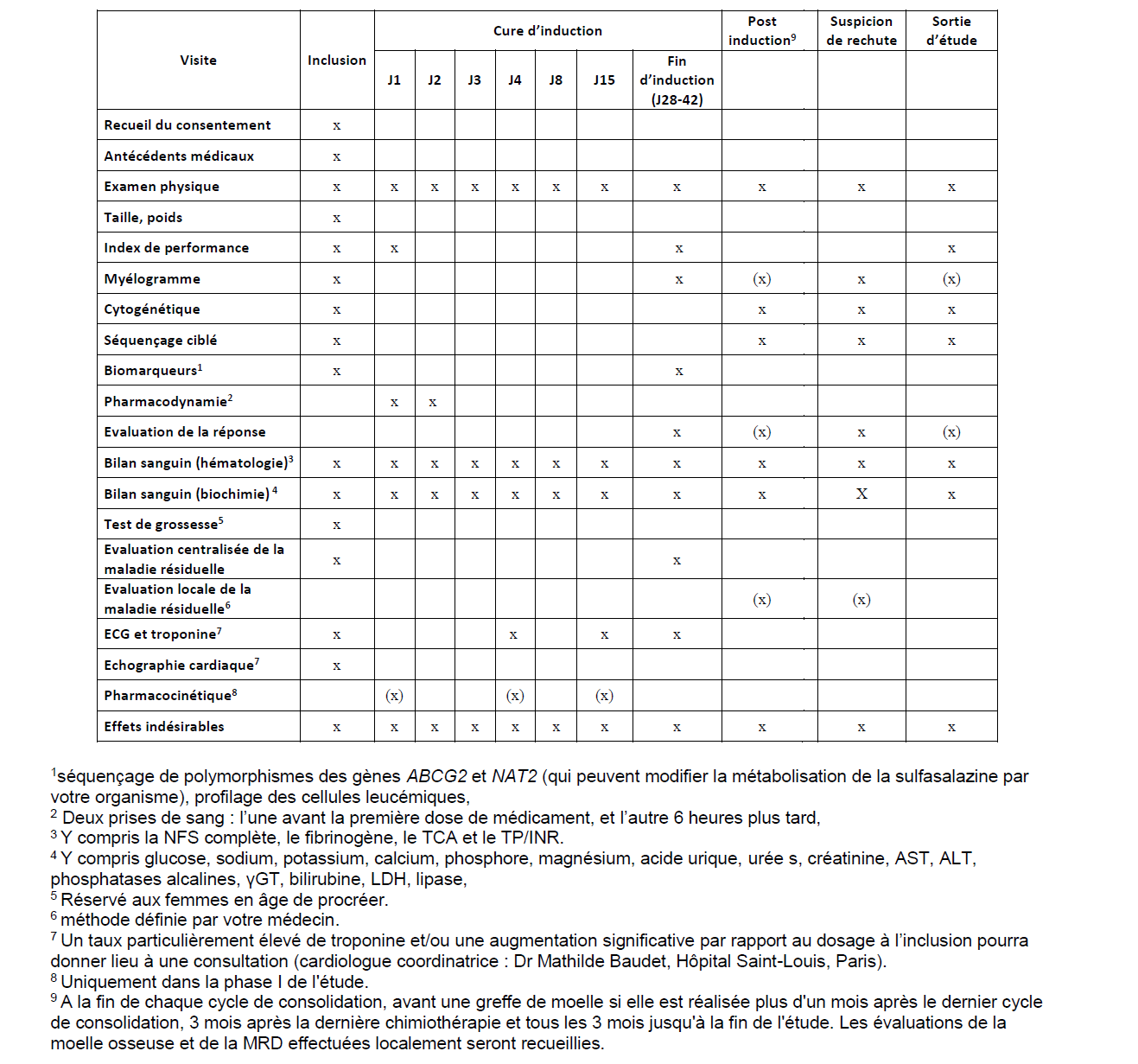
The evaluation of the safety and efficacy of the treatment is based on your medical monitoring, blood tests, bone marrow aspirations (bone marrow smears), and electrocardiograms (“ECG”), as mentioned in Sections 3 and 6 of this information sheet.

Most of these examinations will be performed while you are hospitalized and as part of the usual monitoring of “3+7” induction chemotherapy. After induction, and as indicated in Section 6, the research will require only a few additional blood tests and one additional ECG.

The anticipated duration of the research is approximately 3 years, and your participation will last 14 months.

After signing your consent, the conduct of the research will proceed as follows:

Selection phase
If you decide to participate in this study and sign and date the informed consent form, your physician will request a series of examinations, as follows:

  • A clinical examination,
  • An electrocardiogram (ECG) and a cardiac ultrasound,
  • Blood tests, most of which will be performed as part of routine monitoring,
  • A bone marrow aspiration (myelogram) to assess the biological characteristics of your AML (analysis of chromosomes and genes of acute myeloid leukemia, immunological typing of your leukemic cells). An additional 2 ml of bone marrow will be collected for research purposes.

Hospitalization and Treatment Phase
You will be hospitalized for several weeks during your induction course, until recovery from aplasia. During these hospitalizations, the following examinations will be performed once or several times per week:

  • A record of any adverse events you have experienced,
  • A record of the medications you are currently taking or have recently taken,
  • A clinical examination,
  • Monitoring of your vital signs (blood pressure, temperature),
  • An ECG as part of routine monitoring on Day 1, and for research purposes on Day 4, Day 15, and at the end-of-induction visit,
  • Blood tests. Most of these are performed as part of routine monitoring during a “3+7” induction chemotherapy course (assessment of your biological, biochemical, and coagulation functions), but an additional volume is collected for research purposes (cardiac monitoring by measuring troponin on Day 1, Day 4, Day 15, and at the end-of-induction visit, 5 mL each time). In addition, extra blood samples will be collected for research on Day 1 (45 mL in phase I, 10 mL in phase II), Day 2 (10 mL in phases I and II), Day 4 (45 mL in phase I), and Day 15 (30 mL in phase I only) to measure sulfasalazine levels and evaluate its biochemical effects.

A blood sample and a bone marrow aspiration will also be performed between Day 28 and Day 42, after recovery from aplasia—that is, when your neutrophil count is ≥ 1 G/L and your platelet count is ≥ 100 G/L, or on Day 42 if hematological recovery has not occurred—to assess treatment response and the progression of your AML. An additional 2 mL of bone marrow will be collected for research at this time.

Follow-up Visits after the Induction Course

Depending on the results of the evaluation of your bone marrow at the end of the induction course, your physician may propose rehospitalization for consolidation cycles and/or for hematopoietic stem cell transplantation, if applicable. Aplasia following consolidation chemotherapy and post-transplant aplasia are usually shorter than post-induction aplasia.

A study follow-up visit will take place at the end of each consolidation cycle, when your blood recovery and disease status are reassessed; then prior to transplantation, if it is scheduled more than one month after the last consolidation cycle; and subsequently every three months until your end-of-study visit. The end-of-study visit occurs one year after the completion of your induction course. A visit may also be scheduled by your physician at any time if a relapse of the disease is suspected.

This follow-up schedule does not require any hospitalization or visits beyond routine care.

During these visits, the study physician or a member of the study team may perform the following procedures to assess the effect of the study drug and/or monitor your health status:

  • Record any adverse events you have experienced,
  • Perform a clinical examination,
  • Monitor your vital signs (blood pressure, temperature),
  • Collect blood samples (to monitor your biological, biochemical, and coagulation functions) and, if deemed necessary by the investigator, perform a bone marrow aspiration, to be analyzed locally.

After your completion of the study, minimal information regarding your disease status (remission or relapse) and overall outcome may be periodically requested by the study organizers from your investigator over a period of 5 years, without requiring any direct involvement on your part.

The information provided above is for guidance only. The treatment and its monitoring may be adjusted at any time depending on the progression of your AML or the occurrence of complications.

The expected benefit of the study treatment, sulfasalazine, in addition to standard induction chemotherapy, is an increased likelihood of achieving deep remission of AML (complete remission with negative residual disease) and, consequently, an improved chance of prolonged survival.

Even the lowest dose of sulfasalazine evaluated in this protocol during its first phase may have anti-leukemic activity.

Furthermore, by participating in this study, you will contribute to increasing knowledge about AML treatments and may also help other individuals affected by the same disease.

Certain medications are not permitted:

  • Anti-leukemic treatments other than those described in Section 3 of this information sheet,
  • Red blood cell growth factors (recombinant erythropoietin) or medications stimulating platelet production (thrombopoietin analogues).

Some medications are discouraged unless your investigator considers their use absolutely necessary for your care:

  • Medications belonging to the “purine analogue” family, in particular azathioprine (Imurel®),
  • Digoxin,
  • Ion-exchange resins (such as sodium polystyrene sulfonate, Kayexalate®, or cholestyramine, Questran®).

The additional risks related to the research are those associated with the potential toxicity of sulfasalazine. These risks are well known, given the long-standing market use of this medication, and are variable:

  • The frequency and intensity of the more common adverse events increase with the dose used: fatigue, loss of appetite, nausea, and sometimes vomiting, as well as headaches. Nausea and vomiting will be prevented through the systematic administration of antiemetic medications alongside chemotherapy.
  • Rarely, and independently of the dose, so-called “hypersensitivity” reactions may occur: skin redness, sometimes associated with fever, the appearance of swollen lymph nodes, and various abnormalities detectable through blood tests. Exceptionally, severe, potentially life-threatening inflammatory reactions have been observed. These reactions can affect multiple tissues and organs. Such a reaction could occur while you are under regular clinical and laboratory monitoring; it would be promptly diagnosed and would lead to the immediate discontinuation of sulfasalazine.
  • Hypothetically, sulfasalazine, through a mechanism similar to that affecting leukemic cells, could increase the risk of cardiac toxicity from one of the drugs used in standard induction chemotherapy: idarubicin. For this reason, in addition to the cardiac ultrasound performed before starting treatment, your heart will be frequently monitored by ECG and blood tests (troponin measurement). If necessary, your physician may consult a cardiologist specializing in the management of cardiac issues in cancer patients.

Most of the constraints imposed by this study are those associated with treating AML with standard induction chemotherapy. The additional constraints, limited to the induction course and specifically related to the study, are as follows:

  • Daily oral administration of sulfasalazine during the first 8 to 15 days of your participation in the research.
  • If you participate in the study during its phase 1, small-volume blood samples, but taken repeatedly several times per day, will be collected to monitor the evolution of sulfasalazine blood concentrations (“pharmacokinetics”) on Days 1, 4, and 15. In both phases of the trial, blood will also be drawn twice, six hours apart, on Days 1 and 2, and used to measure various substances indicative of the mechanism of action of sulfasalazine (“pharmacodynamics”).
  • Cardiac tolerance monitoring of sulfasalazine will be performed through blood troponin measurements on Days 1, 4, 15, and at the end-of-induction cycle evaluation (between Days 28 and 42), as well as through an additional ECG (not routinely performed during standard induction chemotherapy monitoring) on Days 4 and 8.

Additionally, an extra 2 mL of bone marrow will be collected during the inclusion myelogram and at the end-of-induction visit (between Days 28 and 42) to measure the sulfasalazine target in leukemic cells and various markers of leukemic cell functional status (“biomarkers”). If you sign the dedicated consent, a genetic analysis of variations (polymorphisms) in two genes that may influence how your body metabolizes sulfasalazine will also be performed.

This study therefore does not require any additional hospitalization or clinic visits beyond those already performed as part of standard induction chemotherapy.

If you agree to participate, you will need to comply with the following points:

  • Attend all scheduled appointments. If this is not possible, please contact your physician as soon as possible.
  • Do not participate in another research study without your physician’s approval.
  • Be affiliated with a social security scheme or be a beneficiary of such a scheme.

Bone marrow samples will be sent to the Hematology Laboratory of Hôpital Saint-Louis for residual disease analysis by flow cytometry, performed as part of routine care.

Two types of samples are used in this research, directed to several central laboratories:

  • Blood samples sent to:
    • The Pharmacology Laboratory of Hôpital Saint-Louis in Paris for pharmacokinetic studies,
    • The INSERM U944 Research Unit of the Saint-Louis Research Institute for pharmacodynamic studies.
  • Bone marrow aspiration samples sent to the INSERM U944 Research Unit of the Saint-Louis Research Institute for pharmacodynamic and biomarker studies.

These analyses will allow the study organizers to investigate the effect of sulfasalazine on your disease and your body. The results will be used exclusively for research purposes. Since these tests are exploratory in nature, they will have no specific consequences for you or for medical conditions affecting your family.

Some samples prepared from the collections performed at study entry and at the end-of-induction treatment evaluation will be frozen and stored at the INSERM U944 unit under the responsibility of Prof. Raphaël Itzykson. At the end of the research, and after declaration to the Ministry of Research and the competent regional health authority (Article L. 1243-3 of the French Public Health Code), these samples may be stored for a maximum of 20 years before being destroyed. They may be used for future AML research to address questions or employ techniques that may emerge as scientific knowledge advances, which cannot be specified today.

The results of these tests will not be routinely communicated to you. However, upon your request, a specific consultation with the study physician may be arranged to share the results of these analyses if available at the time of your request, as well as the overall study results when they become available.

If you decide to withdraw from the study and revoke your consent, you may request in writing that your blood samples not be analyzed within this research. Blood and bone marrow samples will then be destroyed according to local procedures.

The results of these studies may be published in a book or medical journal or used for educational purposes. However, your data will remain confidential; neither your name nor any information that could directly identify you will be used in any publication or educational material.

Your data and biological material may be used for future research or additional analyses, in collaboration with competent authorities or private or public partners, in France or in other countries, including outside the European Union, under conditions that ensure confidentiality and the same level of protection as European legislation. Your data and biological material may, for example, be used for the future development of new treatments, even after the end of this study. These data and materials may be utilized or valorized by the study organizers. You may object at any time to the future use of your data and biological material by contacting the physician overseeing your participation in this research.

You also have the right, at any time, to request from your study physician the destruction of these biological samples or to oppose any future use.

If you decide not to participate in this research, you would most likely receive the same standard treatment with induction chemotherapy (“3+7”), followed, after the end of your participation in the study, by the same treatments: consolidation chemotherapy cycles and/or allogeneic hematopoietic stem cell transplantation.

However, the effectiveness of standard AML treatment is variable, which justifies the exploration of new approaches, such as the addition of sulfasalazine to standard induction chemotherapy, with the aim of improving the rate of deep remissions in AML and, we hope, prolonging survival and potentially increasing the likelihood of cure.

Early termination of participation in the research:

  • Your physician may decide at any time to discontinue your participation and will explain the reasons for this decision.

  • If you decide to withdraw your consent from the research, treatment with sulfasalazine, if still ongoing, will be stopped, and you will no longer be followed within the framework of this study. No further information about you will be collected as part of the research.

Within the framework of the research in which you are invited to participate, your personal data will be processed by AP-HP, the sponsor of the research and data controller, to allow analysis of the study results.

This processing is necessary for the conduct of the research, which falls within the public interest mission of AP-HP as a public hospital-university institution.

For this purpose, your medical data will be transmitted to the Sponsor or to persons or partners acting on its behalf, in France or abroad. These data will be identified by a registration number. They may also be transmitted, under conditions ensuring confidentiality, to French health authorities.

Medical data concerning you that may document a file submitted to the competent authorities regarding the drug evaluated in this research may be transmitted to an industrial partner so that a larger number of patients can benefit from the research results. This transfer will be carried out under conditions that ensure confidentiality.

Your data may also be used for future research or additional analyses related to this study, in collaboration with private or public partners, in France or abroad, under conditions that ensure confidentiality and the same level of protection as required by European legislation.

You may object at any time to the future use of your data by contacting the physician overseeing your participation in this research.

Your data will be retained only for a period strictly necessary and proportionate to the purpose of the research. They will be stored in the information systems of the data controller for up to ten years after the last publication of the research results.

Your data will then be archived in accordance with applicable regulations.

The electronic file used for this research is implemented in compliance with French legislation (the amended “Informatique et Libertés” law) and European regulations (General Data Protection Regulation – GDPR). You have the right to access, rectify, restrict, and object to the processing of data covered by professional confidentiality used in this research. These rights may be exercised through the physician in charge of the study, who is the only person aware of your identity (identified on the first page of this document).

If you decide to withdraw from the research, the data collected prior to your withdrawal will be used in accordance with regulations and exclusively for the purposes of this study. Deleting these data could compromise the validity of the research results. In such a case, your data will absolutely not be used for any subsequent research or for any other purpose.

If you encounter difficulties in exercising your rights, you may contact the Data Protection Officer of AP-HP at protection.donnees.dsi@aphp.fr, who can explain the available avenues for recourse with the CNIL. You may also exercise your right to file a complaint directly with the CNIL. For more information, please visit www.cnil.fr.

AP-HP has taken all necessary measures to conduct this research in accordance with the provisions of the French Public Health Code applicable to research involving human participants.

AP-HP has obtained insurance (No. 0100518814033 220037) covering its civil liability and that of all personnel involved, through the company HDI–GERLING via BIOMEDICINSURE, located at Parc d’Innovation Bretagne Sud C.P.142, 56038 Vannes Cedex.

AP-HP received a favorable opinion from the Sud-Méditerranée II Ethics Committee for the Protection of Persons on 07/07/2022, and authorization from the French National Agency for the Safety of Medicines and Health Products (ANSM) on 10/08/2022.

Your participation in this research is entirely voluntary. Your decision will not affect the quality of care or treatment to which you are entitled.

Before agreeing to participate, you will undergo an appropriate medical examination, the results of which will be communicated to you.

Throughout the study, you may request information regarding your health and explanations about the conduct of the research from the physician overseeing your care.

You may withdraw from the research at any time, without giving a reason, without any impact on your ongoing treatment or the quality of care you receive, and without affecting your relationship with your physician. After withdrawal, you may continue to be followed by the same medical team. In such a case, data collected up to the point of withdrawal will be used for the analysis of the study results.

Your medical records will remain confidential and may only be accessed under the responsibility of the physician in charge of your care, as well as by health authorities or persons duly authorized by AP-HP for research purposes, all of whom are bound by professional confidentiality.

At the end of the research, once the data from this study have been analyzed, you may request to be informed of the overall study results through the physician overseeing your participation in this research.

You also have the right to access all of your medical data, either directly or through a physician of your choice, in accordance with Article L.1111-7 of the French Public Health Code.

After reading all of this information, discussing all aspects with your physician, and taking a reflection period of up to 7 days, if you agree to participate in the research, you will be asked to sign and date the informed consent form located at the end of this document.

eTHEMA study

This study consists in setting up a clinical and biological cohort of leukemias and related diseases (AML, ALL, high-risk MDS, or myelofibrosis linked to an MPN).

It is described as non-interventional since it does not expose you to any new medications, medical devices, or new tools.