- About us
- A new Institute dedicated to combating leukemia
- Our news
- Support us
- You are
- Patients and relatives
- To receive care and support
- Become an expert patient
- Discover the Leukemia Institute
- Researchers
- Research
- Clinical trials
- Discover the Leukemia Institute
- Healthcare professionals
- Refer a patient
- Our clinical research
- Discover the Leukemia Institute
- Industry partners
- Discover the Leukemia Institute
- Translational research
- Donors
- Support us
- Discover the Leukemia Institute
- Care
- Patient care
- Our clinical services
- Our medical laboratories
- Patient information
- Research
- Our research teams
- Our technological platforms
- Our clinical research
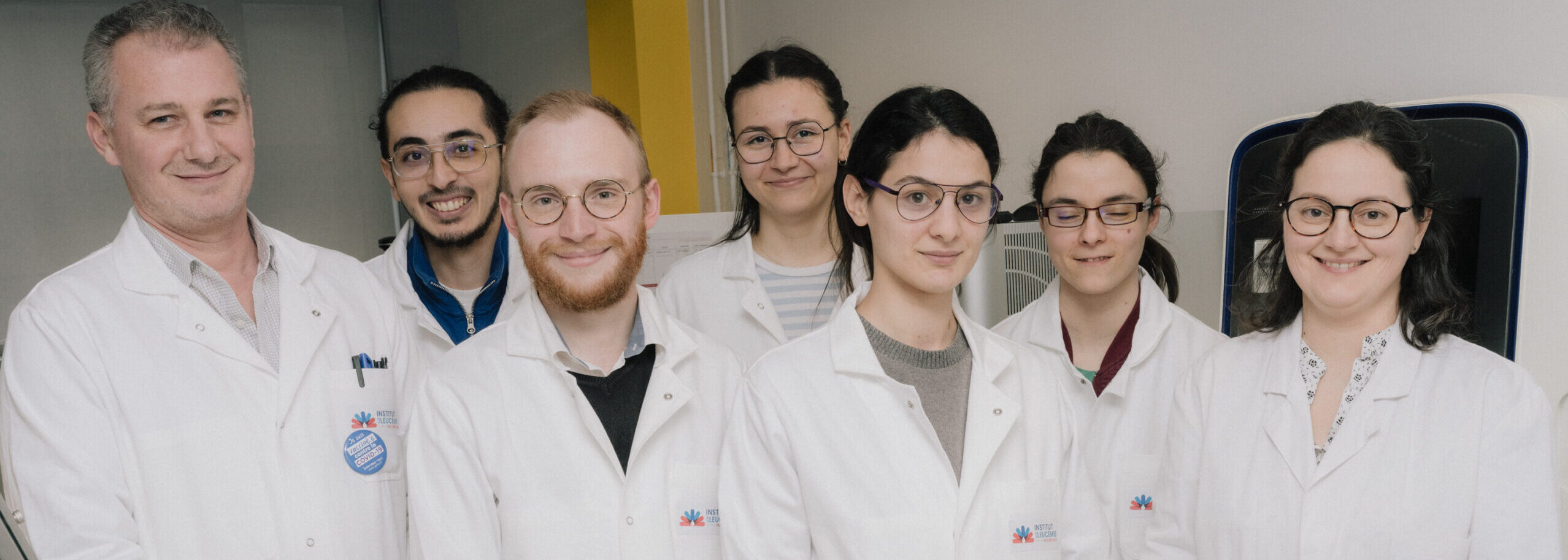
Camille Lobry’s team – Genetic and Epigenetic control of Normal and Malignant Hematopoiesis
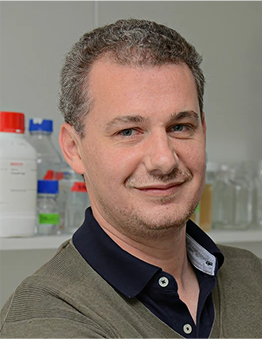
Camille Lobry
Team leader
Institut de recherche Saint-Louis
Research themes

AML is the most common acute leukemia diagnosed in adults and has a dismal overall survival with few targeted therapies. Non-coding regions in the genome play an important role in regulating gene transcription and encompass insulators, enhancers and non-coding RNA. Study of these regions could help decipher leukemogenic mechanisms and help design novel targeted therapies.
Research areas
Super Enhancers (SE) have been characterized as single or group of enhancers with unusual strong enrichment for binding of transcriptional co-activators and strong modifications of histone tails. Leukemic cells often present with altered gene expression patterns and enhancer usage compared to their normal counterparts. SE tend to be enriched around and control genes known to play oncogenic functions. Our results show that SE profiles and activity are depending on oncogenic lesions and particularly that fusion oncogenes can hijack genomic regions to create aberrant de novo SE inducing oncogenes upregulation. We use combinations of genome wide transcriptomic and epigenomic approaches together with high throughput screening technologies based on CRISPR/Cas9, shRNA and CRISPRi to interrogate SE functions and their importance in transcription regulation and leukemia progression.
Essential oncogenes and oncogenics programs, such as MYC, control metabolic gene expression in leukemic cells and induce metabolic shift or reprogramming during transformation and progression of the disease. Conversely, several epigenetic regulators depend on metabolic intermediates to perform their catalytic functions and metabolic dysregulations impact on gene expression programs in leukemic cells. Understanding this interplay could help identify novel vulnerabilities in leukemic cells. In collaboration with Puissant Lab we deploy state of the art in vivo and in vitro models combined with multi-omic characterizations to explore and decipher these intricate mechanisms.
With the advent of massively parallel sequencing and development of many multi-omics techniques, cancer research relies more and more on state of the art molecular biology and bionformatics analyses not easily accessible to regular biologists. Our team helps researcher design and perform classical omics techniques such as RNA-seq, scRNA-seq, ChIP-seq, ATAC-seq and high throughput screening using CRISPR/Cas9 or shRNA and designs standardized bioinformatics analysis pipelines to help researchers explore their data.
Camille Lobry's team members
Camille LobryResearch Director, Team LeaderSéverine LecourtResearch EngineerIsmail El-AzrakAssistant EngineerNaelle GuillonBioinformatics EngineerPaul-Arthur MeslinPhD Student in BioinformaticsChloé ZédouardPhD Student (Joint Supervision with Puissant Lab)Rayan DaherApprentice, M2 BioinformaticsRanya AlawadhiM2 StudentScientific publications
Paul-Arthur Meslin & al, NAR Genomics and Bioinformatics, 2024
PitViper: a software for comparative meta-analysis and annotation of functional screening dataRead the publication
Angela Su & al, Cancer Discov, 2020
The Folate Cycle Enzyme MTHFR Is a Critical Regulator of Cell Response to MYC-Targeting TherapiesRead the publication
Salima Benbarche & al, Science Adv, 2022
Screening of ETO2-GLIS2-induced Super Enhancers identifies targetable cooperative dependencies in acute megakaryoblastic leukemiaRead the publicationFunding
- Our technological platforms
- Our clinical services
- Discover the Leukemia Institute
- Translational research
- Our clinical research
- Clinical trials
- Become an expert patient
- To receive care and support
- Our news
- A new Institute dedicated to combating leukemia