
- About us
- A new Institute dedicated to combating leukemia
- Our news
- Support us
- You are
- Patients and relatives
- To receive care and support
- Become an expert patient
- Discover the Leukemia Institute
- Researchers
- Research
- Clinical trials
- Discover the Leukemia Institute
- Healthcare professionals
- Refer a patient
- Our clinical research
- Discover the Leukemia Institute
- Industry partners
- Discover the Leukemia Institute
- Translational research
- Donors
- Support us
- Discover the Leukemia Institute
- Care
- Patient care
- Our clinical services
- Our medical laboratories
- Patient information
- Research
- Our research teams
- Our technological platforms
- Our clinical research
eTHEMA : The cohort of patients with leukemias
What is the eTHEMA cohort dedicated to leukemias?
This study consists in setting up a clinical and biological cohort of leukemias and related diseases (AML, ALL, high-risk MDS, or myelofibrosis linked to an MPN).
It is described as non-interventional since it does not expose you to any new medications, medical devices, or new tools.
To establish a prospective registry documenting the characteristics of these diseases, the treatments used, as well as the outcomes and the experiences of the patients receiving care.
This study will make it possible to evaluate, in a large patient cohort:
-
The short- and long-term outcomes of patients
-
Quality of life, assessed through your own responses to a specific questionnaire
-
The treatments that are proposed, among the various validated and authorized options currently available
-
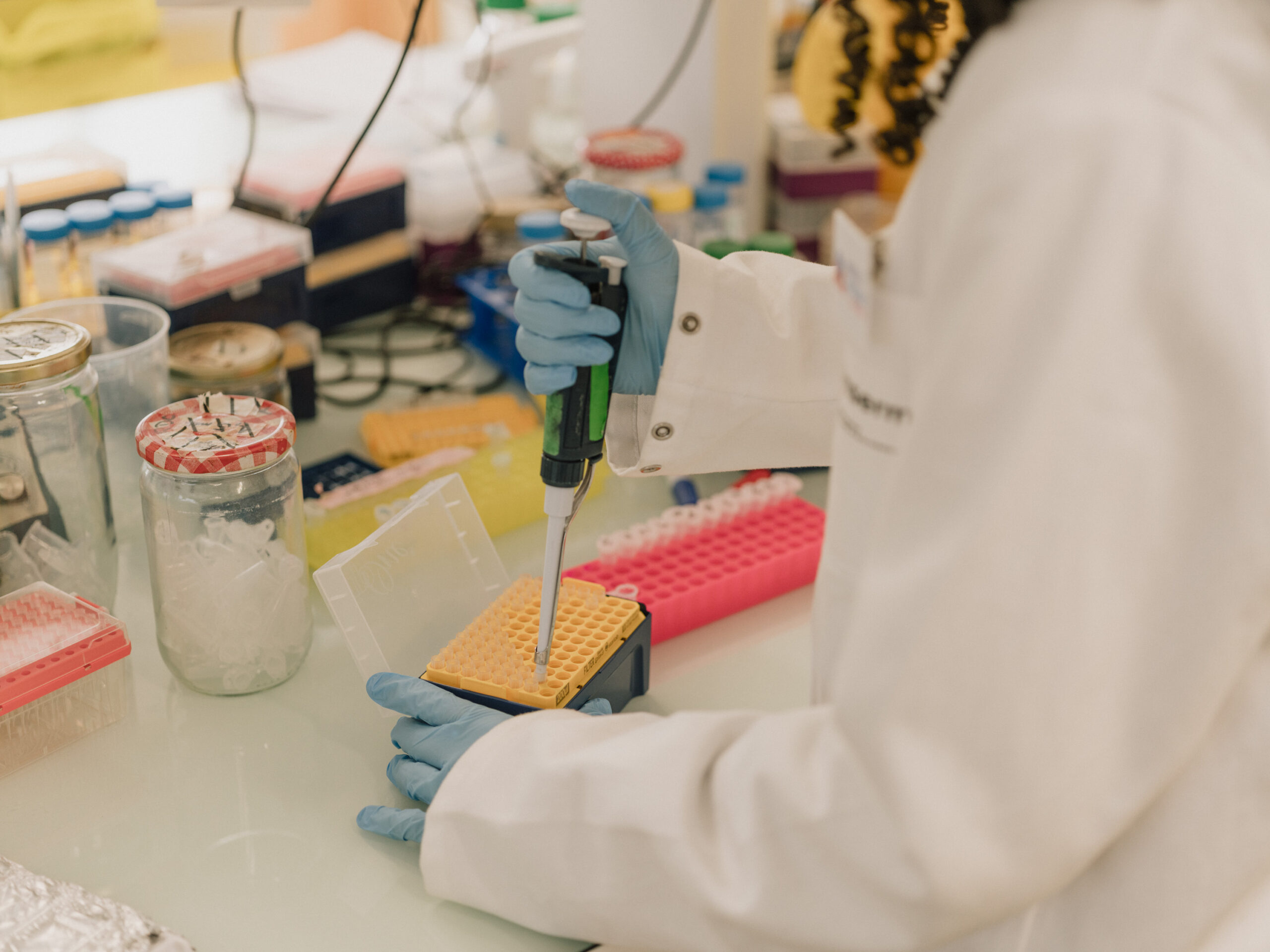
The precise biological characteristics of the different cases of leukemias and related diseases, based on the study of bone marrow or blood cells, or of their molecular components (DNA, RNA, and proteins).
The collection, study, and preservation of biological material thus allows not only for choosing the most appropriate treatment for you and monitoring its effectiveness, but also for advancing general knowledge about these diseases and identifying patients eligible for future research.
Learn more
This cohort dedicated to leukemias will allow:
-
A better understanding of the mechanisms underlying leukemias,
-
The confirmation or discovery of new risk factors,
-
And the conduct of so-called ‘correlative’ biological studies carried out in the laboratory using the cells and serum collected from your blood and bone marrow during your routine exams, or their components (DNA, RNA, or proteins).
These additional volumes of blood and bone marrow will also allow the development of a collection of biological material: serum, cells, and nucleic acids (DNA and RNA) from these cells.
This biological material will be stored, after freezing, in the Biological Resource Center of Saint-Louis Hospital or Robert Debré Hospital, under the responsibility of Professors Jean SOULIER and Hélène CAVE, respectively.
It should be noted that studies conducted on the nucleic acids (DNA/RNA) will allow the exploration of gene mutations associated with your disease.
These analyses are not intended to identify ‘constitutional’ genetic abnormalities.
By participating in this cohort study, you will contribute to a better understanding of leukemias and related diseases, their biological characteristics, the choice of treatments and the treatments actually received, as well as the outcomes of patients receiving care, including long-term outcomes and quality of life.
Your participation is unlikely to provide you with a direct benefit other than contributing to research that ensures the standardization of care and the precise study of your disease characteristics according to the best current standards.
In the future, the data collected in this study may provide a more precise understanding of the characteristics of the disease and the patients, leading to the development of better individualized and more effective treatments from which new patients may benefit.
Participation in this study will not change the choice or nature of the treatment offered to you.
It does not require any specific examinations or additional visits, in particular no extra blood draws or bone marrow samples, beyond those performed as part of the usual monitoring of your disease and treatment.
However, each time these examinations are necessary for your care, whether during your initial treatment or follow-up, an additional volume of blood and bone marrow may be collected to carry out complementary biological research.
This research will notably include the analysis of the sensitivity of leukemic cells to the different available drugs (functional cytometry platform at Saint-Louis Hospital), with the aim of improving treatment possibilities for future patients. These volumes will, however, not exceed 50 ml of blood and 4 ml of bone marrow in total.
It is expected that approximately 2,500 to 3,000 patients will participate in the development of this cohort dedicated to leukemias.
Your individual participation in the study is 15 years, allowing your outcomes, and those of your disease, to be documented over the long term.
The study is planned to remain open for patient inclusion for a period of 5 years.
Your participation in this study is voluntary.
Furthermore, you are free to withdraw from the study at any time.
This can in no way affect your relationship with your doctor or the quality of care you receive.
Main inclusion and exclusion criteria
-
Patient with newly diagnosed de novo, secondary, or treatment-related leukemia, or with related untreated conditions, including acute myeloid leukemia (AML), acute lymphoblastic leukemia (ALL), high-risk myelodysplastic syndrome (MDS), and myelofibrosis associated with myeloproliferative neoplasms (MPN)
- Patient informed and not opposed to participation
- Affiliation with social security or health insurance
-
Related conditions whose morphology is not confirmed (patients with granulocytic sarcoma may be included)
- Prior treatment of related conditions except for:
- Hydroxyurea or prior treatment of myelodysplastic syndrome/myeloproliferative neoplasms in patients with acute myeloid leukemia (AML)
- Steroids, vincristine, prophylactic or therapeutic intrathecal injection, or prior treatment of chronic myeloid leukemia (CML) in ALL patients
- Erythroid-stimulating agents (ESA), luspatercept, granulocyte colony-stimulating factor (G-CSF), eltrombopag or other TPO agonists, iron chelation therapy, hypomethylating agents (HMA), lenalidomide, or any other experimental drug previously used to treat high-risk MDS in HR-MDS patients
- Hydroxyurea, standard or pegylated interferon alpha, ruxolitinib or other JAK inhibitors, busulfan, anagrelide, ESA, or any experimental drug previously used to treat MPN in patients with myelofibrosis associated with myeloproliferative neoplasms
- Patient under guardianship or curatorship
- Patient covered by state medical aid (AME)
- Patient opposes inclusion in the eTHEMA cohort
Number of patients included

Distribution of enrolled patients
Patient recruitment rate
Volunteering
Transparency portal
NEXT-AML
Our project is based on an innovative pharmacological screening method and aims first to establish the feasibility of this real-time approach for patients with relapsed AML.
See the project
NICHE-RESIST
Identification of targetable oncogenic addictions responsible for chemoresistance mediated by the tumor micro-environment in AML
- Our technological platforms
- Our clinical services
- Discover the Leukemia Institute
- Translational research
- Our clinical research
- Clinical trials
- Become an expert patient
- To receive care and support
- Our news
- A new Institute dedicated to combating leukemia


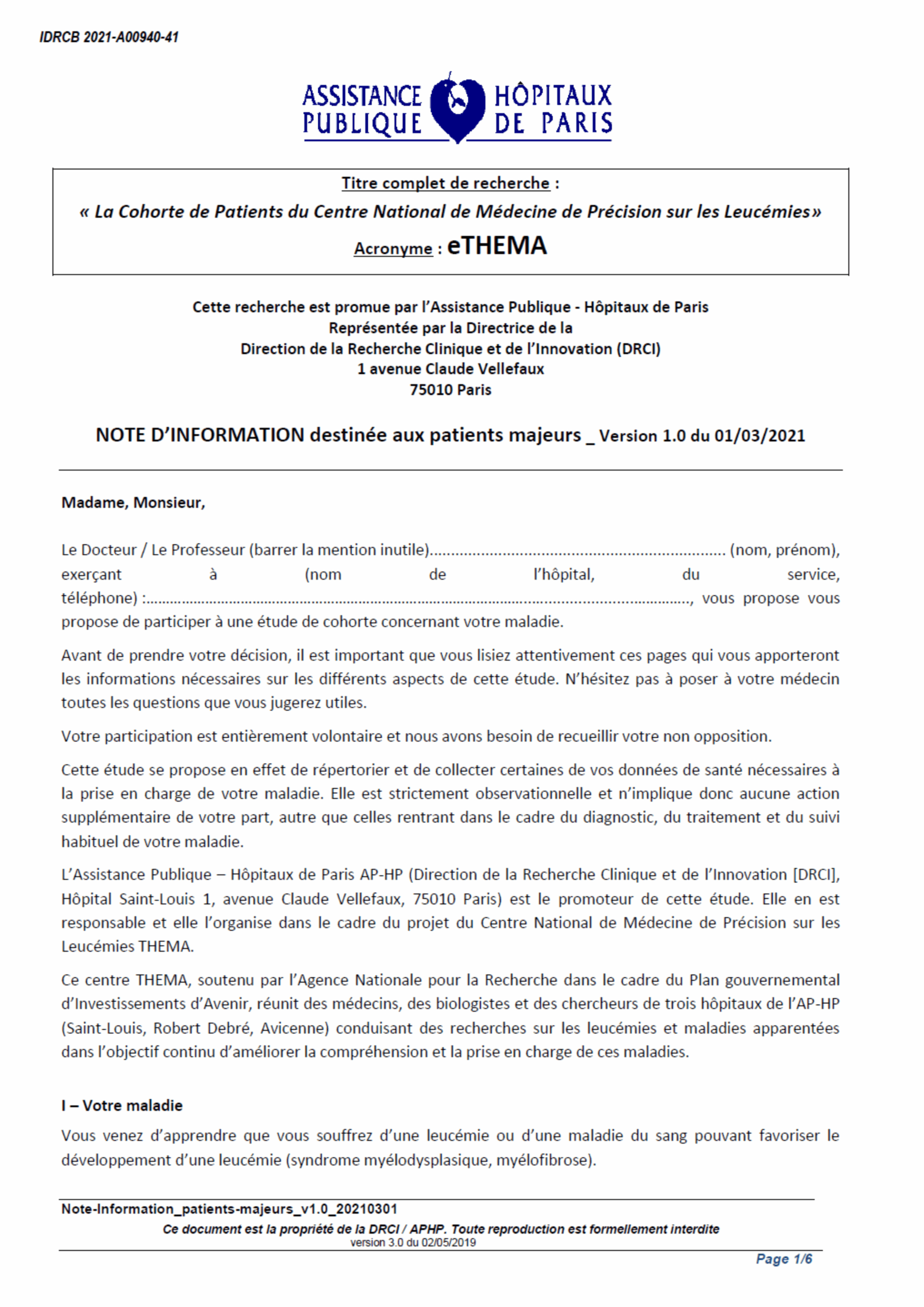

It is important that you read these pages carefully, as they will provide you with the necessary information on the various aspects of this study. Do not hesitate to ask your doctor any questions you deem useful.
Your participation is entirely voluntary, and we need your consent.
This study aims to record and collect some of your health data necessary for the management of your illness. It is strictly observational and therefore does not require any additional action on your part, other than those required for the diagnosis, treatment, and routine monitoring of your illness.
The Assistance Publique – Hôpitaux de Paris AP-HP (Clinical Research and Innovation Department [DRCI], Saint-Louis Hospital, 1 avenue Claude Vellefaux, 75010 Paris) is the sponsor of this study. It is responsible for it and is organizing it as part of the National Center for Precision Medicine on Leukemia (THEMA) project. This THEMA center, supported by the National Agency for Research as part of the government’s Future Investment Plan, brings together doctors, biologists and researchers from three AP-HP hospitals (Saint-Louis, Robert Debré, Avicenne) conducting research on leukemia and related diseases with the ongoing aim of improving the understanding and management of these diseases.
You have just learned that you have leukemia or a blood disorder that can promote the development of leukemia (myelodysplastic syndrome, myelofibrosis).
In these diseases, abnormal cells accumulate in the bone marrow and sometimes in the blood.
This can lead to a failure to produce normal blood cells, such as red blood cells (their reduction causes anemia that can require blood transfusions), white blood cells (their reduction causes frequent and/or serious infections, particularly bacterial infections, and therefore fever), and platelets (their reduction causes bleeding).
These diseases form a heterogeneous group, which can now be characterized in each individual patient by studying their cellular and molecular characteristics in the laboratory. Therapeutic management depends on these characteristics, but also on your age and general condition, as well as your medical history and associated illnesses. Depending on these various factors, your doctor may suggest treatments of varying intensity, often based on chemotherapy drugs, possibly followed by a hematopoietic stem cell transplant.
At this stage, your hematologist has diagnosed your disease. They have sufficiently specified the subtype to be able to offer you appropriate treatment, although a more detailed characterization of your disease will need to be continued in the laboratory. They will decide as a team, during a multidisciplinary consultation meeting (RCP), which treatment is best suited to your disease and your health status, among the various options available. The study in which we are inviting you to participate does not impose any choice of treatment among these options; there is no direct comparison between treatment groups, nor is there any random selection.
As part of this study, your personal data will be processed by the Clinical Research and Innovation Department (DRCI) of the AP-HP, sponsor of the study and responsible for data processing, to enable analysis of the results within the framework of the THEMA center.
This processing is necessary to conduct research, which fulfills the public interest mission entrusted to the AP-HP as a public university hospital.
The categories of data collected for this observatory are health data.
The purpose of the processing of personal data is medical research on leukemia and blood diseases that can promote the development of leukemia (myelodysplastic syndrome, myelofibrosis).
The legitimate interest of the THEMA center and the AP-HP, which is medical research on these diseases, represents the legal basis for the processing of this data.
Their processing
The personnel involved in the study are bound by professional secrecy. Your personal data required for the study will be transmitted after encryption for computer processing and analysis. Your data will be collected in “pseudonymized” form, i.e., identified by a code number and the first letter of your first and last name. In addition to the medical and clinical research team, a representative of the sponsor, such as an auditor, a clinical research technician, or a representative of the French or foreign health authorities, bound by professional secrecy, may have access to your file to verify the compliance of the data collected. In addition to the sponsor and investigators at the THEMA center, the recipients of your encrypted personal data will be the two subcontractors mentioned below:
The computer file used for this research is implemented in accordance with French regulations (the “Informatique et Libertés” law of January 6, 1978, revised following Ordinance No. 2018-1125 published in the Official Journal on December 13, 2018) and European regulations (General Data Protection Regulation – GDPR).
You have the right to access, rectify, limit, and object to the processing of data covered by professional confidentiality used in this research. These rights can be exercised by contacting the physician in charge of the research, who alone knows your identity (identified on the front page of this document).
If you decide to stop participating in the research, the data collected prior to this will be used. in accordance with regulations, and exclusively for the purposes of this research. Indeed, their deletion would likely compromise the validity of the research results. In this case, your data will absolutely not be used subsequently or for other research.
Their use
Your data will be used solely for scientific research purposes with the aim of improving the understanding and management of leukemia and related diseases.
The results of this study may be published in a book or medical journal or used for educational purposes. However, your data will remain confidential; neither your name nor any information that could directly identify you will be used in any publication or educational material. Your data and biological material may be the subject of subsequent research or additional analyses by public or private partners in France or in other countries, including outside the European Union, in collaboration with the competent authorities and under conditions ensuring their confidentiality and the same level of protection as European legislation.
Your data and biological material may, for example, be used for the further development of new treatments, even after the end of this study.
You may object at any time to the further use of your data by contacting the physician treating you as part of this research.
Retention
Your data and biological material will only be kept for a period strictly necessary and proportionate to the purpose of the research.
In accordance with current regulations, your data and biological material will be kept for a maximum period of 25 years by the sponsor and in the study’s biological resource center.
Your data will then be archived in accordance with current regulations.
Your participation in this research study is entirely free and voluntary. Your decision will not affect the quality of care and treatment you are entitled to. If you do not wish to participate in the research, simply inform your doctor.
You will be able to request information about your health and an explanation of the research process from your doctor throughout and at the end of the research study.
Research Rights
You have the following rights regarding your personal data: right to transparency, right of access, right to modification, right to object, right to be forgotten, right to restriction, right to portability. The processing of your data does not involve automated individual decision-making.
These rights may be exercised with the center’s physician, who alone knows your identity. They may also be exercised with the study sponsor’s data protection officer, whose contact details are provided above.
Your medical records will remain confidential and may only be accessed under the responsibility of the physician overseeing your treatment, as well as by individuals duly authorized by the sponsor for the research and bound by professional confidentiality.
At the end of the research and after analysis of the data relating to this research, you may be informed of the overall results by the physician treating you as part of this research. You can also access all of your medical data directly or through a doctor of your choice in accordance with the provisions of Article L 1111-7 of the Public Health Code.
Withdrawal rights
You may withdraw from the research study at any time without justification, without impact on the continuation of your treatment or the quality of care provided to you, and without any impact on your relationship with your physician. Following this withdrawal, you may be monitored by the same medical team. In this case, the data collected up to the time of your withdrawal will be used to analyze the research results. You may also refuse to participate in the aforementioned biological collection and request the destruction of your samples at any time or object to their use.
If you decide to stop participating in the research study, the data collected prior to this withdrawal will be used in accordance with regulations and exclusively for the purposes of this research study. Indeed, their deletion would likely compromise the validity of the research results. In this case, your data will absolutely not be used subsequently or for any other research study.
Recourse
If you have any difficulty exercising your rights, you can contact the AP-HP Data Protection Officer at the following address: protection.donnees.dsi@aphp.fr, who will be able to explain the avenues of appeal available to you with the CNIL.
You can also exercise your right to complain directly to the CNIL either by mail: 3 Place de Fontenoy TSA 80715, 75334 PARIS CEDEX 07 or by telephone at 01 53 73 22 22 (for more information on this subject, visit www.cnil.fr).
The sponsor has taken all necessary measures to conduct this research in accordance with the provisions of the French Health Code applicable to research involving human subjects.
The sponsor received a favorable opinion for this research from the EST I Committee for the Protection of Persons on September 9, 2021.